Potassium (K) is one of the essential macronutrients required by all plants.
Potassium deficiency is common in Mediterranean soils and can significantly reduce yields in many crops, including olive trees.
The olive tree is considered a potassium- and calcium-demanding crop. It is particularly sensitive to boron deficiency and responds strongly to nitrogen applications. A targeted, well-timed and integrated nutrition strategy, including potassium applications both through the root system and the foliage, combined with suitable nutritional and biostimulant products, can support high and high-quality olive yields without depleting the soil.
It can also improve tolerance to abiotic stress and help reduce year-to-year yield fluctuations associated with alternate bearing.
Role of Pottasium in Olive trees
For olive trees, potassium is important for:
- the healthy and stress-free development of leaves, shoots and fruits,
- fruit size, weight and oil content,
- tolerance to stress conditions, particularly water stress and drought,
and ultimately for achieving high yields, good fruit quality and earlier harvesting.δής.
More specifically:
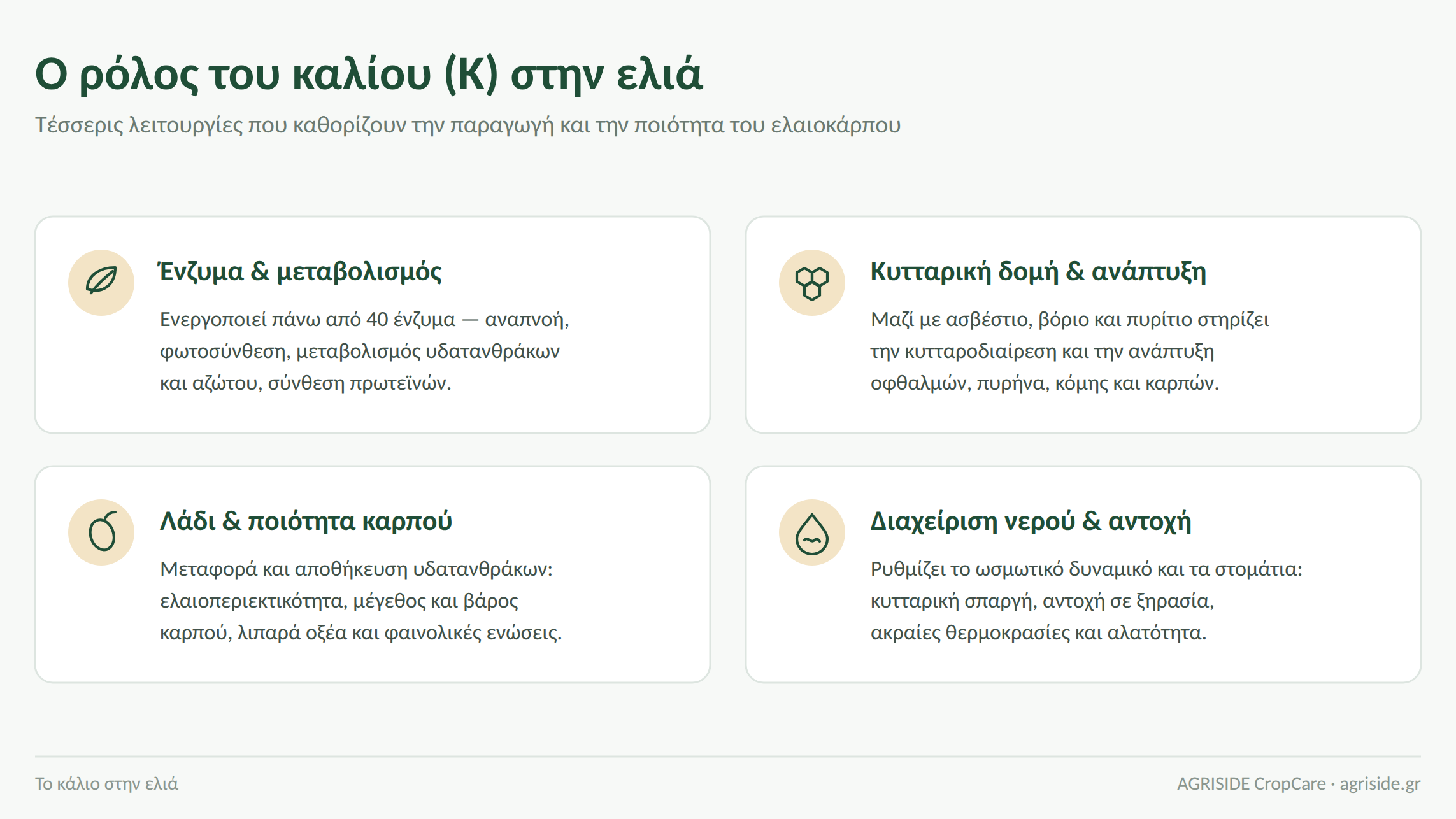
- It is involved in the activation and activity of more than 40 enzymes associated with essential tree functions, including respiration, photosynthesis, carbohydrate and nitrogen (N) metabolism, and protein synthesis.
- Together with calcium, boron and silicon, it is essential for proper cell division, strengthening of cell structure and healthy cell development. It therefore supports the proper development of buds, the stone, the canopy and the fruits, while enhancing the tree’s natural resistance mechanisms.
- It is essential for the transport and storage of carbohydrates and therefore for oil accumulation in the fruit, as well as for increasing flesh development and fruit weight. It also contributes to improved organoleptic characteristics of both the fruit and olive oil by increasing fatty acids and phenolic compounds.
- It plays a key role in water management within the tree by regulating the osmotic potential of cells and stomatal opening, promoting cell turgor and increasing tolerance to water deficiency. It also improves irrigation-use efficiency.
- Through its positive effect on the ratio of unsaturated to saturated fatty acids, the retention of fluids within the vacuoles and the regulation of sodium (Na) fluxes, potassium contributes not only to tolerance against osmotic stress, but also to improved resistance to extreme temperatures and salinity.
Requirements and Deficiency
Olive trees have high potassium requirements from April through October, with peak demand occurring during July and August.
According to experimental data, producing 60–80 kg of olives per tree requires:
| Element | Required dose rate per tree |
| Nitrogen (N) | 0,8 – 1,5 κιλά nitrogen /tree. |
| Phosphorus (P) | 0,25 – 0,35 κιλά phosphorus/tree. |
| Potassium (K) | 0,7 – 1,1 κιλά potassium/tree. |
These quantities of nutrients are removed from the orchard through fruit harvest, with the greatest nutrient removal occurring in years of high production. Since nutrients are also removed through pruning, the required replacement amounts increase depending on the intensity of the pruning that has been carried out or is planned.
The minimum amount of potassium that should be replenished in fruit-bearing years, when no potassium deficiency is present, is 1 kg K₂O per tree per year. In cases of potassium deficiency, 2–5 kg K₂O should be applied. This amount may be supplied at a higher rate every two years or at standard rates annually. In high-yielding years, with production reaching approximately 100 kg of fruit per tree, an application of 1.7 kg K₂O per tree may be used to cover the requirements of both the canopy and the rhizosphere.
In productive years and in mature trees, potassium application should generally be at a rate twice that of nitrogen, while maintaining an appropriate balance between potassium, magnesium and calcium (Mg+Ca/K) through suitable magnesium and calcium applications.
Naturally, the results of soil analysis play a decisive role in determining the appropriate potassium application rate.
Deficiency Symptoms
Potassium is a mobile nutrient within the plant; therefore, the first symptoms of potassium deficiency appear on the older leaves. Initially, chlorotic to yellowish areas develop without a clearly defined boundary between the chlorotic and green tissue, gradually taking on a bronze coloration. At later stages, scorched-looking necrotic areas appear at the leaf tips, which may curl, or along the margins of the leaf blades.
In advanced deficiency, the necrotic areas spread toward the interveinal regions and the base of the leaves. Fruits remain small, shoot growth is restricted, and both fruit and olive oil production are reduced. Premature leaf drop and shoot dieback may also occur.
| Caution: Visual symptoms alone do not allow a reliable diagnosis of potassium deficiency, as similar symptoms may also be caused by chloride salts or impaired root function. In addition, latent deficiency may occur before the condition becomes severe enough to produce clearly visible symptoms. |
Leaf Tissue Analysis
For accurate assessment, leaf samples should be collected from 20 productive and representative olive trees within the orchard. A total of 200 mature, healthy leaves should be analyzed, collecting 4 leaves per shoot in July (5–8 weeks after full bloom) or in late autumn from the middle section of the most recent growth (5–8 months old). Samples should consist of the 4th–5th pair of leaves from the tip of current-season, non-fruiting shoots.
In other words, leaf tissue analysis should be carried out on productive trees.
A very satisfactory potassium concentration in olive leaves ranges from 0.7% to 1.65% of dry matter, with an optimum level of approximately 0.9–1.0%. In cases of potassium deficiency, leaf potassium concentration may range from 0.1% to 0.5% of dry matter, with visible deficiency symptoms generally appearing when potassium levels fall to 0.3% or below. έως 0,5% ξηρού βάρους, με εκδήλωση συμπτωμάτων όταν η περιεκτικότητα πέσει στο 0,3% και κάτω.
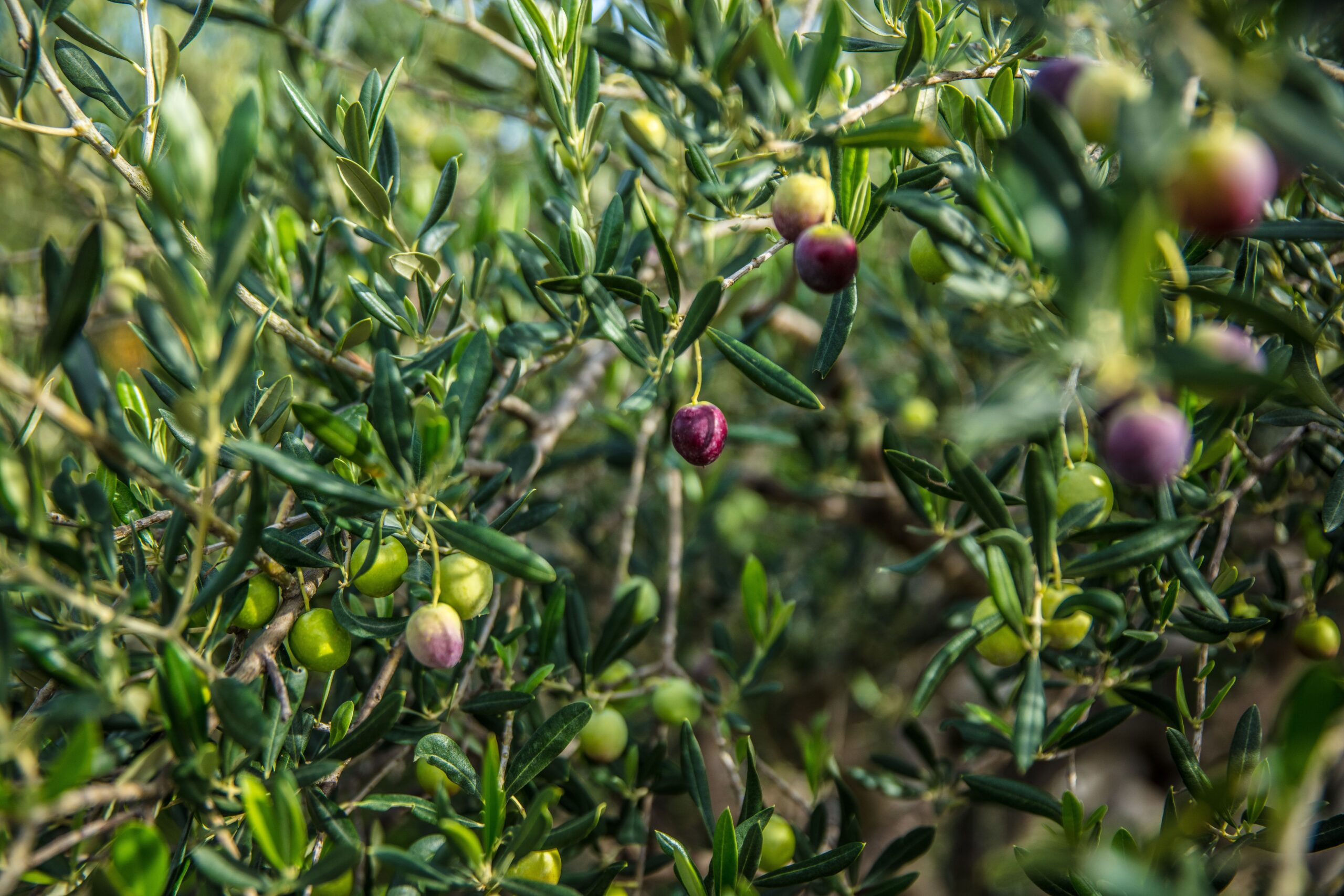
Potassium Deficiency
Potassium deficiency may occur in:
- Acidic soils (low pH)
- Sandy or light-textured soils (leaching)
- Areas with high rainfall (leaching)
- Intensively irrigated soils
- Drought conditions (potassium may become fixed in clay minerals)
- Heavy clay soils (especially those rich in illite)
- Soils with low potassium reserves
- Magnesium-rich soils (nutrient antagonism)
- Trees with a poorly developed root system
Application of Nutritional Products
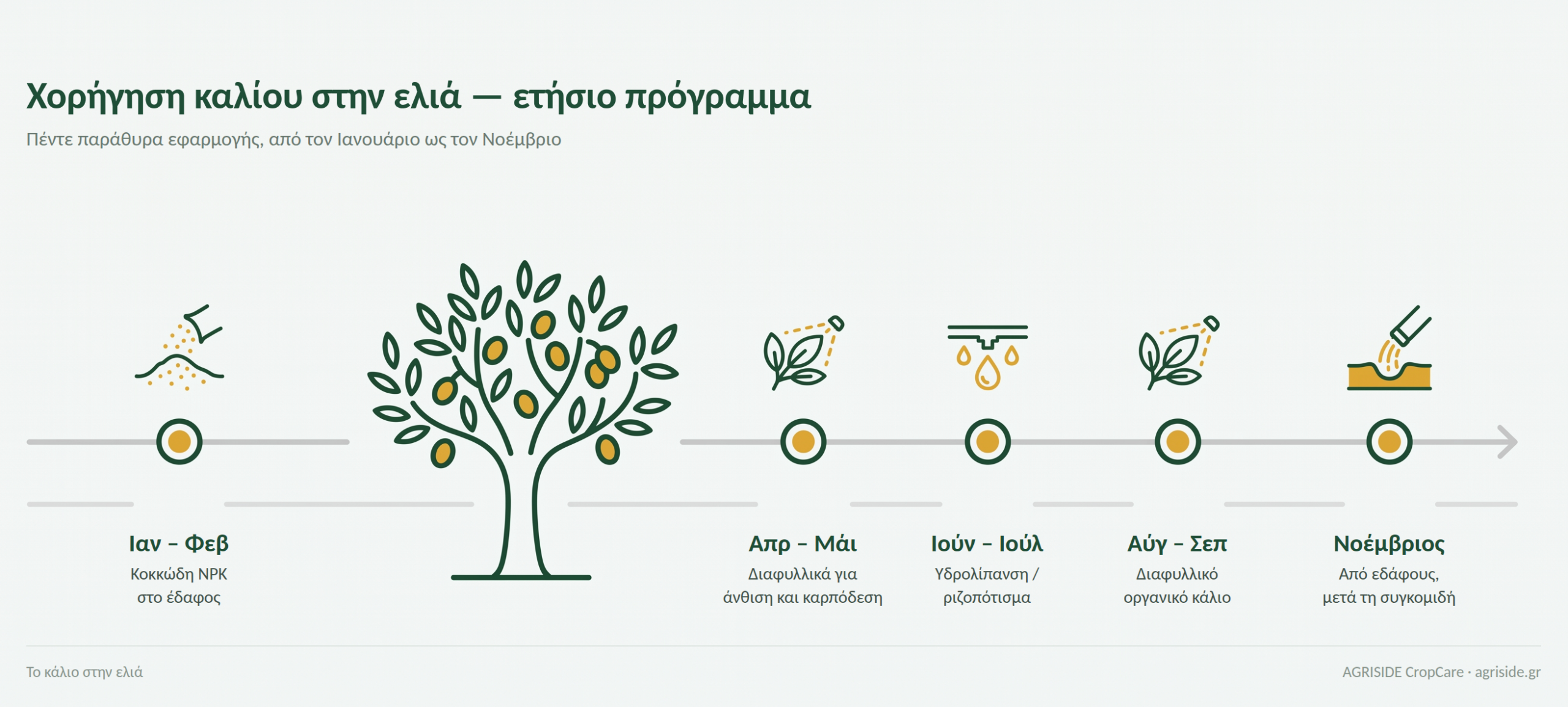
The application of granular NPK fertilizers to the soil during winter (January–February) helps replenish soil nutrient reserves and ensures nutrient availability in the rhizosphere at the beginning of the new vegetative growth period in March–April, supporting canopy renewal and bud development.
Foliar applications during April–May with products containing potassium, phosphorus, boron, molybdenum and other micronutrients contribute to good flowering and fruit set. One such specialized product is MAXIVOL 0.5-16-21 + Trace Elements + 5% Free Amino Acids (w/w).
Potassium applications during June–July, through fertigation or root drenching, using NPK fertilizers such as KRYSTAL OPTY 20-20-20 or KRYSTAL KALI PLUS 12-8-26 + 10CaO + Trace Elements, as well as potassium sulfate (K₂SO₄) or potassium nitrate (KNO₃), support increases in fruit size, weight and oil accumulation.
A humic extract containing a significant amount of potassium used during the extraction process may also be applied at this stage, such as AGRIHUM 26, containing 26% humic extract (humic and fulvic acids) and 8% K₂O (w/w). In addition to supplying potassium, it helps improve soil fertility and stimulates root development and nutrient uptake. MAXIVOL may also be applied as a foliar treatment during this period.
From mid-August until early September, foliar applications of products containing organic potassium, such as potassium citrate, provide a readily assimilable source of potassium through the leaves and can play an important role in increasing fruit oil content. Such products include PLONVIT KALPRIM with 22% K₂O (w/w) and MADUREL with 20% K₂O + 2% Proline + 30% Organic Acids (w/w).
After harvest, while the root system is still active (November), soil application of potassium helps replenish the tree’s nutrient reserves and supports fruit production in the following season.
Frequently Asked Questions
How much potassium does an olive tree need per year?
The minimum amount that should be replenished in a fruit-bearing year, when no potassium deficiency is present, is 1 kg K₂O per tree per year. If potassium deficiency is present, the rate increases to 2–5 kg K₂O per tree. In high-yielding trees producing around 100 kg of olives per tree, the application rate may reach 1.7 kg K₂O per tree.
When should foliar potassium be applied to olive trees?
There are two main application windows. The first is April–May, using products containing potassium, phosphorus, boron and molybdenum to support flowering and fruit set. The second is from mid-August to early September, using products containing organic potassium, such as potassium citrate, which can play an important role in increasing fruit oil content.
How can I distinguish potassium deficiency from other causes?
Visual inspection alone is not sufficient. Similar symptoms may be caused by chloride salts or poor root function, while latent potassium deficiency may also occur without visible symptoms. Leaf tissue analysis is required: 200 leaves should be collected from 20 productive and representative trees, either in July or in late autumn.
What potassium concentration in olive leaves is considered adequate?
A potassium concentration of 0.7% to 1.65% of dry matter is considered satisfactory, with an optimum range of approximately 0.9–1.0%. Levels below 0.5% indicate deficiency, while visible symptoms generally appear when potassium concentration falls to 0.3% or below.
In which soils does potassium deficiency occur more frequently?
Potassium deficiency occurs more frequently in acidic, sandy or light-textured soils, under conditions of high rainfall or intensive irrigation due to leaching, in heavy clay soils rich in illite, under drought conditions, in soils rich in magnesium due to nutrient antagonism, and in trees with a poorly developed root system.